
The simplest definition of the word Reiki is Universal or Spiritual (Rei) – Life Force or Energy (Ki). It is a simple and powerful system of energy work that anyone can learn to use for developing physical, emotional, mental and spiritual harmony and wholeness in themselves and for assisting others.
It is believed that healing energy flows through the practitioner’s hands when they are placed on or near the recipient. Some traditions emphasize the importance of the practitioner’s intention and presence, while others teach that the recipient’s own energy draws what is needed to support the body’s natural healing response. Reiki is said to carry an innate intelligence—guiding the energy to where it is most needed, even if the practitioner’s hands are not placed directly on that area.
When we think of healing, we often picture a
healthy physical body—but true healing is about
wholeness. It is the restoration of balance across all levels of our being: physical, emotional, mental, and spiritual. When the mind, body, and spirit fall out of harmony, dis-ease can arise.
Lasting well-being comes from realigning the whole self—not only within, but also in connection with the Earth and the greater Universe. The path to healing begins the moment we choose to return to balance and remember our natural state of wholeness.
Without the motivation to be well and the intention to act in our own behalf we can not become well.
Reiki is a means to empowering us to become whole in all ways.
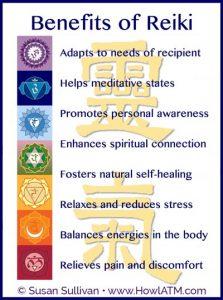
Although Reiki carries a spiritual quality, it is not a religion. There is no expectation to change your personal beliefs when receiving or practicing Reiki. You are welcome to keep your own spiritual or religious path and are free to decide what feels right for you.
Reiki works gently alongside many forms of healing, including conventional medicine such as medication, surgery, and mental health care, as well as other holistic therapies. Reiki is not a replacement for medical treatment, nor should it delay seeking care from a qualified healthcare professional. It is best understood as a complementary practice that supports your overall well-being in partnership with your doctor.
Reiki works gently alongside many forms of healing, including conventional medicine such as medication, surgery, and mental health care, as well as other holistic therapies. Reiki is not a replacement for medical treatment, nor should it delay seeking care from a qualified healthcare professional. It is best understood as a complementary practice that supports your overall well-being in partnership with your doctor
What Is A Reiki Attunement?
The ability to channel Reiki is received through a process known as Attunement. During this sacred exchange, a Reiki teacher (Reiki Master) passes on the capacity to work with Reiki energy.
The attunement helps clear energetic blocks and opens your energy field, allowing Reiki to flow through you. This direct transmission connects you to the Reiki current, activating your ability to channel healing energy through your aura and hands.
Many energy-healing systems use attunement, and Reiki is one of the most well-known. It is a simple, accessible, and versatile practice—free from heavy dogma or complicated rituals—making it an excellent foundation for anyone beginning an energy-healing path.
Once attuned, the ability to channel Reiki remains with you for life. And while the connection is permanent, the learning is ongoing—each practitioner continues to grow and discover new layers of understanding.
The attunement helps open the palm chakras and energy pathways, as needed, and connects you to the unique Reiki Shakti healing frequencies, allowing the energy to flow with ease and intention.
Attunement also enables us to direct Reiki energy with intention for specific purposes. It is typically received as part of formal instruction in the techniques used to practice Reiki.
Reiki is most often taught in three levels: I, II, and III, with Level III being the Master/Teacher level.
- Level I focuses on the foundations of Reiki, teaching hands-on techniques for self-healing and working with others.
- Level II introduces methods for distance healing and includes an attunement to Reiki symbols, which support mental and emotional healing and strengthen the flow of Reiki energy.
- Level III (Master/Teacher) deepens the spiritual and intuitive aspects of Reiki and grants the ability to attune others, allowing them to become Reiki practitioners themselves.
Each level builds upon the last, expanding both understanding and connection to the Reiki energy. Become a Reiki Practitioner.
After becoming a Reiki practitioner, you do not diagnose medical conditions. It is important to avoid alarming clients or crossing legal boundaries reserved for licensed healthcare professionals.
You may ask supportive questions and gently suggest that a client consult a doctor or qualified healthcare provider if there are areas of concern. Reiki is offered as a complementary practice and is not a substitute for medical care.
Using Gems
Crystals As Lifestyle Aids
How To’s
- Empowering Yourself
- How to Use Candles
- How to Use Healing Wands
- How to Use Moon Energy
- How to Burn Sage